Saturday, April 10, 2010
Host-guest chemistry
In supramolecular chemistry, host-guest chemistry describes complexes that are composed of two or more molecules or ions that are held together in unique structural relationships by forces other than those of full covalent bonds. Host-guest chemistry encompasses the idea of molecular recognition and interactions through noncovalent bonding. Noncovalent bonding is critical in maintaining the three-dimensional structure of large molecules, such as proteins and is involved in many biological processes in which large molecules bind specifically but transiently to one another. There are four commonly mentioned types of non-covalent interactions: hydrogen bonds, ionic bonds, van der Waals forces, and hydrophobic interactions.

Rotaxane
A rotaxane is a mechanically-interlocked molecular architecture consisting of a "dumbbell shaped molecule" which is threaded through a "macrocycle" (see graphical representation). The name is derived from the Latin for wheel (rota) and axle (axis). The two components of a rotaxane are kinetically trapped since the ends of the dumbbell (often called stoppers) are larger than the internal diameter of the ring and prevent disassociation (unthreading) of the components since this would require significant distortion of the covalent bonds.
Much of the research concerning rotaxanes and other mechanically-interlocked molecular architectures, such as catenanes, has been focused on their efficient synthesis. However, examples of rotaxane have been found in biological systems including: cystine knot peptides, cyclotides or lasso-peptides such as microcin J25 are protein, and a variety of peptides with rotaxane substructure.
Mechanically-interlocked molecular architectures
Mechanically-interlocked molecular architectures are connections of molecules not through traditional bonds, but instead as a consequence of their topology. This connection of molecules is analogous to keys on a key chain loop. The keys are not directly connected to the key chain loop but they cannot be separated without breaking the loop. On the molecular level the interlocked molecules cannot be separated without significant distortion of the covalent bonds that make up the conjoined molecules. Examples of mechanically-interlocked molecular architectures include catenanes, rotaxanes, molecular knots, and molecular Borromean rings.
The synthesis of such entangled architectures has been made efficient through the combination of supramolecular chemistry with traditional covalent synthesis, however mechanically-interlocked molecular architectures have properties that differ from both “supramolecular assemblies” and “covalently-bonded molecules”. Recently the terminology "mechanical bond" has been coined to describe the connection between the components of mechanically-interlocked molecular architectures. Although research into mechanically-interlocked molecular architectures is primarily focused on artificial compounds many examples have been found in biological systems including: cystine knots, cyclotides or lasso-peptides such as microcin J25 are protein, and a variety of peptides. There is a great deal of interest in mechanically-interlocked molecular architectures to develop molecular machines by manipulating the relative position of the components.
Protein subunit
In structural biology, a protein subunit or subunit protein is a single protein molecule that assembles (or "coassembles") with other protein molecules to form a protein complex: a multimeric or oligomeric protein. Many naturally-occurring proteins and enzymes are multimeric. Examples include: oligomeric: hemoglobin, DNA polymerase, nucleosomes and multimeric: ion channels, microtubules and other cytoskeleton proteins. The subunits of a multimeric protein may be identical, homologous or totally dissimilar and dedicated to disparate tasks. In some protein assemblies, one subunit may be referred to as a "regulatory subunit" and another as a "catalytic subunit." An enzyme composed of both regulatory and catalytic subunits when assembled is often referred to as a holoenzyme. One subunit is made of one polypeptide chain. A polypeptide chain has one gene coding for it – meaning that a protein must have one gene for each unique subunit.
A subunit is often named with a Greek or Roman letter, and the numbers of this type of subunit in a protein is indicated by a subscript. For example, ATP synthase has a type of subunit called α. Three of these are present in the ATP synthase molecule, and is therefore designated α3. Larger groups of subunits can also the specified, like α3β3-hexamer and c-ring.
Biochemistry
Biochemistry is the study of the chemical processes in living organisms. It deals with the structures and functions of cellular components such as proteins, carbohydrates, lipids, nucleic acids and other biomolecules.
Among the vast number of different biomolecules, many are complex and large molecules (called polymers), which are composed of similar repeating subunits (called monomers). Each class of polymeric biomolecule has a different set of subunit types. For example, a protein is a polymer whose subunits are selected from a set of 20 or more amino acids. Biochemistry studies the chemical properties of important biological molecules, like proteins, and in particular the chemistry of enzyme-catalyzed reactions.
The biochemistry of cell metabolism and the endocrine system has been extensively described. Other areas of biochemistry include the genetic code (DNA, RNA), protein synthesis, cell membrane transport, and signal transduction.
Protein nuclear magnetic resonance spectroscopy
Protein nuclear magnetic resonance spectroscopy (usually abbreviated protein NMR) is a field of structural biology in which NMR spectroscopy is used to obtain information about the structure and dynamics of proteins. The field was pioneered by, among others, Kurt Wüthrich, who shared the Nobel Prize in Chemistry in 2002. Protein NMR techniques are continually being used and improved in both academia and the biotech industry. Structure determination by NMR spectroscopy usually consists of several following phases, each using a separate set of highly specialized techniques. The sample is prepared, resonances are assigned, restraints are generated and a structure is calculated and validated.
Structural biology
Structural biology is a branch of molecular biology, biochemistry, and biophysics concerned with the molecular structure of biological macromolecules, especially proteins and nucleic acids, how they acquire the structures they have, and how alterations in their structures affect their function. This subject is of great interest to biologists because macromolecules carry out most of the functions of cells, and because it is only by coiling into specific three-dimensional shapes that they are able to perform these functions. This architecture, the "tertiary structure" of molecules, depends in a complicated way on the molecules' basic composition, or "primary structures."
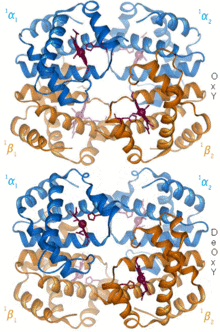

Biomolecules are too small to see in detail even with the most advanced light microscopes. The methods that structural biologists use to determine their structures generally involve measurements on vast numbers of identical molecules at the same time. These methods include:
- Macromolecular crystallography,
- NMR,
- Cryo-electron microscopy (cryo-EM)
- Multiangle light scattering,
- Small angle scatterng,
- Ultra fast laser spectroscopy, and
- Dual Polarisation Interferometry and circular dichroism.
X-ray crystallography
X-ray crystallography is a method of determining the arrangement of atoms within a crystal, in which a beam of X-rays strikes a crystal and diffracts into many specific directions. From the angles and intensities of these diffracted beams, a crystallographer can produce a three-dimensional picture of the density of electrons within the crystal. From this electron density, the mean positions of the atoms in the crystal can be determined, as well as their chemical bonds, their disorder and various other information.
Since many materials can form crystals — such as salts, metals, minerals, semiconductors, as well as various inorganic, organic and biological molecules — X-ray crystallography has been fundamental in the development of many scientific fields. In its first decades of use, this method determined the size of atoms, the lengths and types of chemical bonds, and the atomic-scale differences among various materials, especially minerals and alloys. The method also revealed the structure and functioning of many biological molecules, including vitamins, drugs, proteins and nucleic acids such as DNA. X-ray crystallography is still the chief method for characterizing the atomic structure of new materials and in discerning materials that appear similar by other experiments. X-ray crystal structures can also account for unusual electronic or elastic properties of a material, shed light on chemical interactions and processes, or serve as the basis for designing pharmaceuticals against diseases.
Polymer
A polymer is a large molecule (macromolecule) composed of repeating structural units typically connected by covalent chemical bonds. While polymer in popular usage suggests plastic, the term actually refers to a large class of natural and synthetic materials with a wide variety of properties.
Because of the extraordinary range of properties accessible in polymeric materials, they play an essential and ubiquitous role in everyday life—from plastics and elastomers on the one hand to natural biopolymers such as DNA and proteins that are essential for life on the other. A simple example is polyethylene, whose repeating unit is based on ethylene (IUPAC name ethene) monomer. Most commonly, as in this example, the continuously linked backbone of a polymer used for the preparation of plastics consists mainly of carbon atoms. However, other structures do exist; for example, elements such as silicon form familiar materials such as silicones, examples being silly putty and waterproof plumbing sealant. The backbone of DNA is in fact based on a phosphodiester bond, and repeating units of polysaccharides (e.g. cellulose) are joined together by glycosidic bonds via oxygen atoms.
Sulfur
Sulfur or sulphur (pronounced /ˈsʌlfər/ SUL-fər, see spelling below) is the chemical element that has the atomic number 16. It is denoted with the symbol S. It is an abundant, multivalent non-metal. Sulfur, in its native form, is a bright yellow crystalline solid. In nature, it can be found as the pure element and as sulfide and sulfate minerals. It is an essential element for life and is found in two amino acids: cysteine and methionine. Its commercial uses are primarily in fertilizers, but it is also widely used in black gunpowder, matches, insecticides and fungicides. Elemental sulfur crystals are commonly sought after by mineral collectors for their brightly colored polyhedron shapes. In nonscientific contexts, it can also be referred to as brimstone.
Oxygen
Oxygen, from the Greek roots ὀξύς (oxys) (acid, literally "sharp", from the taste of acids) and -γενής (-genēs) (producer, literally begetter), is the element with atomic number 8 and represented by the symbol O. It is a member of the chalcogen group on the periodic table, and is a highly reactive nonmetallic period 2 element that readily forms compounds (notably oxides) with almost all other elements. At standard temperature and pressure two atoms of the element bind to form dioxygen, a colorless, odorless, tasteless diatomic gas with the formula O2. Oxygen is the third most abundant element in the universe by mass after hydrogen and helium and the most abundant element by mass in the Earth's crust.[2] Diatomic oxygen gas constitutes 20.9% of the volume of air.
Nitrogen
Nitrogen is a chemical element that has the symbol N, atomic number of 7 and atomic mass 14.00674 u. Elemental nitrogen is a colorless, odorless, tasteless and mostly inert diatomic gas at standard conditions, constituting 78% by volume of Earth's atmosphere.
Many industrially important compounds, such as ammonia, nitric acid, organic nitrates (propellants and explosives), and cyanides, contain nitrogen. The extremely strong bond in elemental nitrogen dominates nitrogen chemistry, causing difficulty for both organisms and industry in breaking the bond to convert the N2 into useful compounds, but releasing large amounts of often useful energy, when these compounds burn, explode, or decay back into nitrogen gas.
The element nitrogen was discovered by Scottish physician Daniel Rutherford in 1772. Nitrogen occurs in all living organisms. It is a constituent element of amino acids and thus of proteins, and of nucleic acids (DNA and RNA). It resides in the chemical structure of almost all neurotransmitters, and is a defining component of alkaloids, biological molecules produced by many organisms.
Hydrogen
Hydrogen is the chemical element with atomic number 1. It is represented by the symbol H. With an atomic weight of 1.00794 u, hydrogen is the lightest and most abundant chemical element, constituting roughly 75 % of the Universe's elemental mass. Stars in the main sequence are mainly composed of hydrogen in its plasma state. Naturally occurring elemental hydrogen is relatively rare on Earth.
Carbon
Carbon is the chemical element with symbol C and atomic number 6. As a member of group 14 on the periodic table, it is nonmetallic and tetravalent—making four electrons available to form covalent chemical bonds. There are three naturally occurring isotopes, with 12C and 13C being stable, while 14C is radioactive, decaying with a half-life of about 5730 years. Carbon is one of the few elements known since antiquity. The name "carbon" comes from Latin language carbo, coal.
There are several allotropes of carbon of which the best known are graphite, diamond, and amorphous carbon. The physical properties of carbon vary widely with the allotropic form. For example, diamond is highly transparent, while graphite is opaque and black. Diamond is among the hardest materials known, while graphite is soft enough to form a streak on paper (hence its name, from the Greek word "to write"). Diamond has a very low electrical conductivity, while graphite is a very good conductor. Under normal conditions, diamond has the highest thermal conductivity of all known materials. All the allotropic forms are solids under normal conditions but graphite is the most thermodynamically stable.
Protein structure
Proteins are an important class of biological macromolecules present in all biological organisms, made up of such elements as carbon, hydrogen, nitrogen, oxygen, and sulphur. All proteins are polymers of amino acids. According to their physical size, proteins are nanoparticles (definition: 1-100 nm). The polymers, also known as polypeptides, consist of a sequence of 20 different L-α-amino acids, also referred to as residues. For chains under 40 residues the term peptide is frequently used instead of protein. To be able to perform their biological function, proteins fold into one or more specific spatial conformations, driven by a number of noncovalent interactions such as hydrogen bonding, ionic interactions, Van Der Waals forces and hydrophobic packing. To understand the functions of proteins at a molecular level, it is often necessary to determine their three dimensional structure. This is the topic of the scientific field of structural biology, that employs techniques such as X-ray crystallography, NMR spectroscopy,and Dual Polarisation Interferometry to determine the structure of proteins.
Molecule
A molecule is defined as an electrically neutral group of at least two atoms in a definite arrangement held together by very strong (covalent) chemical bonds. Molecules are distinguished from polyatomic ions in this strict sense. In organic chemistry and biochemistry, the term molecule is used less strictly and also is applied to charged organic molecules and biomolecules.
In the kinetic theory of gases, the term molecule is often used for any gaseous particle regardless of its composition. According to this definition noble gas atoms are considered molecules despite the fact that they are composed of a single non-bonded atom.
A molecule may consist of atoms of a single chemical element, as with oxygen (O2), or of different elements, as with water (H2O). Atoms and complexes connected by non-covalent bonds such as hydrogen bonds or ionic bonds are generally not considered single molecules.
Dynamic covalent chemistry
In supramolecular chemistry, dynamic covalent chemistry is a strategy that aims at synthesizing large complex molecules. In it a reversible reaction is under thermodynamic reaction control and a specific reaction product out of many is captured . Because all the components in the reaction mixture are able to equilibrate quickly, (according to its advocates) some degree of error checking and proof reading is enabled. The concept of dynamic covalent chemistry was demonstrated in the development of specific molecular Borromean rings.
The underlying idea is that rapid equilibration allows the coexistence of a huge variety of different species among which one can select molecules with desired chemical, pharmaceutical and biological properties. For instance, the addition of a proper template will shift the equilibrium toward the component that forms the complex of higher stability (thermodynamic template effect). After the new equilibrium is established, the researcher modifies the reaction conditions so as to stop equilibration. The optimal binder for the template is then extracted from the reactional mixture by the usual laboratory procedures.
Supramolecular systems
Chemists have demonstrated that artificial supramolecular systems can be designed that exhibit molecular recognition. One of the earliest examples of such a system are crown ethers which are capable of selectively binding specific cations. However, a number of artificial systems have since been established.
Biological systems
Molecular recognition plays an important role in biological systems and is observed in between receptor-ligand, antigen-antibody, DNA-protein, sugar-lectin, RNA-ribosome, etc. An important example of molecular recognition is the antibiotic vancomycin that selectively binds with the peptides with terminal D-alanyl-D-alanine in bacterial cells through five hydrogen bonds. The vancomycin is lethal to the bacteria since once it has bound to these particular peptides they are unable to be used to construct the bacteria’s cell wall.
Molecular recognition
The term molecular recognition refers to the specific interaction between two or more molecules through noncovalent bonding such as hydrogen bonding, metal coordination, hydrophobic forces, van der Waals forces, pi-pi interactions, electrostatic and/or electromagnetic effects. The host and guest involved in molecular recognition exhibit molecular complementarity.
Subscribe to:
Comments (Atom)